

The Art of Attention: What a 500-Year-Old Sculpture Can Teach Us About Receptivity
Dr. Karen e. bOHLIN & aSHLEIGH rEEN
Culture & Society
Five hundred years ago, a sculptor in western France carved a figure that refuses to be understood from a single vantage point. You must move to see her. You must look again. She does not yield herself to a glance; she requires our attention. This is not an accident.
Unfortunately, attention is a scarce resource—and scarcer still in the digital age. The science is clear: our attention is divided. We are tethered to our phones, apps, and computers. Our minds jump from notification to worry. Algorithms track our interests and monetize our distraction. We struggle to focus on one thing at a time. We've diagnosed the problem with impressive precision, and attention science has become its own field. The self-help industry is replete with advice: digital detoxes, mindfulness apps, productivity systems designed to hack our wandering brains back into focus.
But our crisis of attention is not primarily technological. It’s formational. We have been trained in the posture of reaching and grasping, believing that every moment requires our immediate reaction. Intellectually, we seek quick takeaways and even conclusions before we've considered the evidence.
But some forms of knowing do not yield to this kind of activity. They require receptivity.
We tend to approach the problem the way we approach everything else in our culture: as something we need to master through activity, effort, and control. What can I do to fix my attention? How can I optimize my focus? We seek out one more podcast, one more system, one more thing to do. What if we have the right data but are asking the wrong question?
What if, instead of asking what we must do to fix our attention, we ask what we must receive to re-tune it? Aesthetic experience invites precisely this kind of encounter. But it requires a posture of receptivity our productivity-obsessed culture has largely forgotten.
The Difference Between Activity and Receptivity
We tend to think of ourselves as agents who act upon the world. Activity is our default mode: we are actors, reaching out, doing, making, producing. And those contributions matter. We become who we are through our choices. But if we insist that our lives only take shape through willful self-determination, then we fail to see another way of being that's equally active, even though it looks quite different. This brings us to the concept of “receptivity.”
Consider your hands. Activity is reaching out, throwing a baseball, lifting a toddler, stirring a pot on the stove. Passivity is letting our hands fall limp, not extending them in welcome or help, not using them for work or creativity, just allowing them to be inert.
Receptivity is different from both activity and passivity. It is what we do with our hands, when we cup them to drink water, forming our palms to receive so we can bring the water to our lips. Receptivity still requires agency; we are engaged. We have to position our hands so the water doesn’t leak through our fingers. To receive is still to act, but it is a posture, an orientation, rather than an assertion.
This distinction matters when it comes to attention. The question is not simply "what do we need to do to fix our broken attention?" but "what posture is required of us to allow our attention to be properly captured?"
Take, for example, a musician tuning a guitar. She needs to adjust the strings to match the pitch. If the strings are too loose, the guitar produces a dull, flat sound, close to the right note, but not quite there. Conversely, if she cranks the strings too tight, they snap altogether—too much effort and control break the string itself. The musician does not invent the pitch; she listens for it. She plucks a string, listens carefully, makes a small adjustment, then plucks and listens again.
This tuning assumes a prior openness to something else. It requires receptivity and a readiness to adjust, to orient ourselves to hear the pitch. The same is true of a new parent: the sleeplessness, the competing demands, the sheer chaos of those early weeks—what makes any of it wise rather than frantic is the parent’s genuine openness to this particular person—attentive to what this child, right now, actually needs. Receptivity focuses us.
Eugen Herrigel illustrates receptivity in his 1948 classic Zen in the Art of Archery. The protagonist, Herrigel, travels to Japan to study kyudo under a Zen master. At first, he approaches archery as a technique to be mastered, even conquered through sheer force. Yet he fails repeatedly and embarrassingly because, as his master points out, “the right shot at the right moment does not come because you do not let go of yourself” (25). Herrigel asserts himself onto the bow, attempting to bend it to his own will, yet all his efforts to hit the target fail.
His master continues, “What stands in your way is that you have a much too willful will. You think that what you do not do yourself does not happen" (26). Herrigel’s mistake is assuming that the bow must submit to him. Once he assumes a new posture, orienting himself towards the bow rather than asserting himself over it, the shot finds its mark. Rather than trying to dominate the bow, he learns to assume a new posture.
Put another way: Our attention needs to be captivated before it can be truly tuned. Receptivity to something outside ourselves recalibrates what we notice and care about. Art invites something similar from us. Demanding not so much analysis, but presence, art hones our posture of receptivity.
When Encounter Reshapes Attention
Our encounters with art do something brain-training cannot: they reorient what we're aiming at. This is why aesthetic experience matters: it provides the encounter that nurtures our receptivity and trains us to see. It is not a break from the serious work of professional life or moral formation. Instead, it is that work itself.
In a recent program we co-hosted with the Harvard Catholic Forum—Practical Wisdom through the Arts—we invited busy professionals and graduate students to slow down and practice receptivity through encounters with art and poetry. What follows is an invitation to one such encounter. We invite you to receive it as we describe it, slowly, without reaching for interpretation before the artwork has had its say. We invite you to assume a receptive posture with us.
An Invitation to See
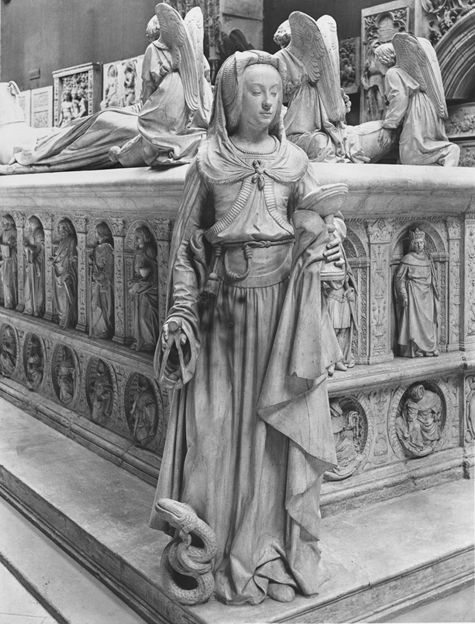
The culminating encounter in our seminar series features a sculpture on a tomb in a cathedral in western France. We have returned to it again and again because it stages, in stone, the very movement our attention needs to relearn. It does not reward the hurried or yield itself to the glance. It asks something of the viewer.
Many of our students are drawn to her calm. Her face is set with serenity and strength. When we zoom in, they are struck by her high forehead, her gaze focused downward—at what? They notice her elegant attire, headdress, and veil. Is she regal? Her stance appears grounded and composed. Look more closely at her expression. Her countenance is contemplative yet self-possessed. She’s not a frozen statue but a living presence. There's humanity here. Who is she? What is going on?
She is absorbed by something in her left hand. What is it? Let’s zoom in.
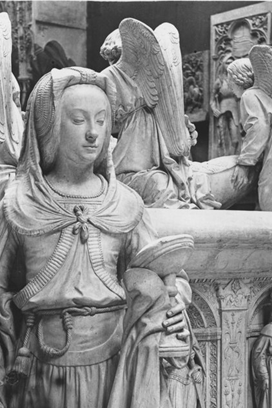
Her gaze is fixed on the object. “Is it a cup, a chalice?” one of our students wonders. It has a long stem. Its surface, however, is convex and raised, not concave like a cup. “It’s a mirror,” another suggests. “She’s looking at her reflection.” This proves compelling and easily validated on closer examination. Her attention is fixed on what it reveals. Her raised eyebrows make sense now—she's examining and discerning herself. The mirror catches and reflects the truth. It shows things as they are.
Her Right Foot
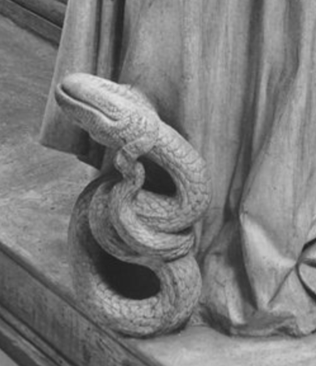
If we look down, we see a snake coiled around her right foot. Its body twisted in an ambiguous position. Is its head upside down? The snake is a traditional symbol of wisdom, but also of danger, of the knowledge of good and evil. Wisdom requires discernment.
Her Right Hand
Let’s take a look at her right hand.
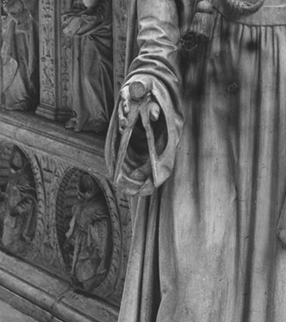
She is holding an inverted V shaped object. “Is that a mathematical compass?” a student asks. “Yes, you use it for drawing circles and for measuring.” A mathematical instrument, the compass helps one to determine proportion and perspective and to gain one’s proper bearings. The symbols are beginning to speak: a mirror and a compass, counterbalancing reflection and direction, discernment and measured action.
The Full Figure
Look at her again now, taking in the whole. Her countenance, her hands, her dress. Everything speaks of someone engaged in the careful work of seeing, discerning, preparing for “right” action, to borrow from Aquinas. Her dress itself is rendered with remarkable detail, the folds and fabric suggesting dignity and movement. She’s three dimensional. Let’s walk around to the other side to take her in fully.
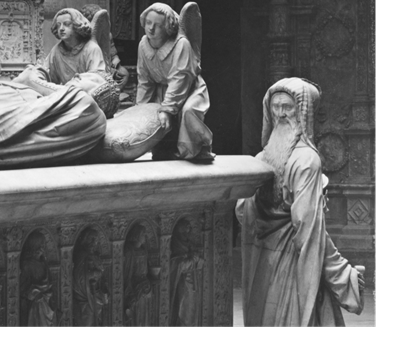
The woman’s elegant dress and posture remain the same. Behind her flowing veil, in the back of her head, is the startling image of an old man whose face emerges seamlessly yet shockingly. There is no evidence of this man from the front. He assumes no other physical form except that of an aged human face, weathered and worn, looking backward toward the tomb itself.
Who is this creature? Why this Janus-faced depiction? The ancient Roman god Janus was depicted looking backward and forward and represented hindsight and foresight, the guardian of time and thresholds. (Etymologically, this is the origin of the month of January—a threshold for each new year.)
Taken together, we have a young woman and a much older man. They each hold memories of the past and promises for the future. The compass suggests foresight. The mirror reflects the reality of the present moment. The snake warns that wisdom requires navigating danger and ambiguity.
When we reveal this reverse view in our seminar, there is an audible gasp. The surprise stops them in their tracks. Their attention is newly captivated. This is what we mean by aesthetic experience: not passive consumption, but active encounter. Attention is arrested and held not by force of will but by receptivity to beauty, complexity, truth.
Who Was She?
The tomb this figure decorates was commissioned in 1502 by Anne of Brittany, Queen of France, to honor her parents. This particular figure of Prudence is identified as a portrait of Anne herself. Contemporary poets praised Anne's prudence as her chief virtue. The sculptor Michel Colombe, working in the late Gothic tradition at the dawn of the Renaissance, chose to represent her and her namesake virtue not as a static symbol, but as a dynamic figure that must be fully seen to be understood.
Colombe's genius lies in his restraint and his revelation. The front view is beautiful but conventional, inviting quiet contemplation. Only those who take the time to walk around, to see from multiple perspectives, discover the full truth. This is sculptural pedagogy. It trains the viewer into a kind of understanding that cannot be rushed. The choice to make Prudence intelligible only through movement is itself a claim about what prudence is.
Prudence: An Encounter
Here we meet Prudence as a lived reality, rather than an abstract idea. These elements together capture Thomas Aquinas's account of the cardinal virtue of prudence, which integrates memory of the past, understanding of the present, and foresight of the future. For Aquinas, writing in the thirteenth century, prudence was "right reason applied to action," the intellectual virtue that guides all moral virtues. It is what the Greeks called phronesis, practical wisdom.
In classical and medieval thought, prudence was not timidity or mere caution. It was a form of wisdom that enables us to deal with the particular, the contingent, and the ambiguous, particularly in situations when there is no rule that can simply be applied. Prudence does not replace courage, justice, or temperance. It directs them in context. Justice without prudence, for example, becomes rigid legalism. Courage without prudence devolves to recklessness. Self-mastery without prudence is joyless self-denial.
The sculpture tells this story. The mirror speaks to seeing reality as it is. The compass speaks to measure and proportion. The snake speaks to alertness and the recognition that reality contains danger and ambiguity. And that double face—that startling union of youth and age—embodies the classical insight: wise action requires an integrated relationship to time. Memory matters. Foresight matters. Understanding the present matters.
The important thing to note, of course, is that the sculpture does not yield these themes at first glance—it requires the viewer to approach, to attend, and to move. Similarly, the Zen archery master did not matter-of-factly explain how to shoot an arrow. He invited Herrigel to assume a different posture. Assuming a posture of receptivity means recognizing that some forms of knowing require a different kind of attention than active analysis can provide. Some truths reveal themselves only to those who stand receptively before them, who linger long enough to see and be moved before they try to master. This is prudence as a training ground for attention.
The Four Cardinal Virtues
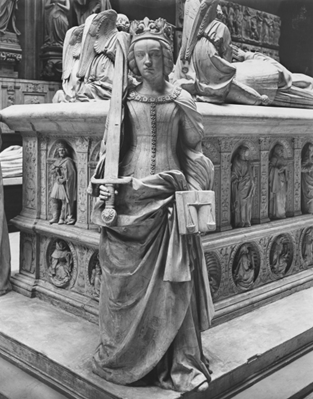
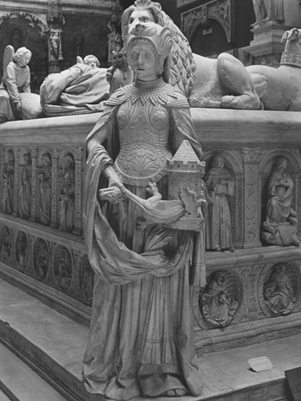
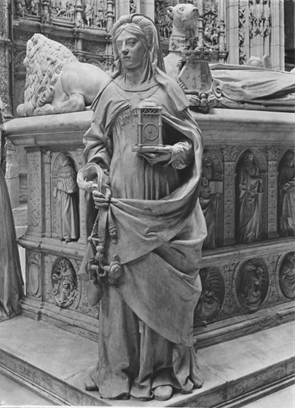
If you visit the tomb in Nantes Cathedral and walk around to view the other cardinal virtues—Justice, Fortitude, Temperance—you'll find them rendered stiff, emblematic, frozen in symbolic postures, carrying their attributes like props. They appear more like icons than persons. Prudence alone draws you in emotionally. Prudence alone has depth, warmth, and surprise. Prudence alone requires you to move, to see her fully, to receive what is before you and what is hidden from view.
What This Teaches About Attention
The tomb in Nantes Cathedral is an important case study on attention. When we linger with a work of art—resisting the impulse to immediately check the wall label—we assume a posture of receptivity. We practice sitting with ambiguity. We practice letting questions arise without rushing to answer them. We practice forming ourselves to receive what the work has to offer rather than imposing our preconceptions upon it.
In the end, receptivity is the active work of learning to see—of allowing something outside ourselves to command our attention and trusting that the encounter itself has value, even before we fully understand it. The sculpture of Prudence teaches what philosophical argument alone cannot: that wisdom requires seeing from multiple angles, that the truth is often more complex than it first appears, that patient attention reveals what hurry cannot. But it can only teach this if we allow it to.
The negative consequences of impatient attention show up everywhere. In relationships, where we fail to attend to the full context of what someone is trying to communicate, hearing only what confirms our assumptions. In public discourse, where we cannot hold multiple perspectives in tension, only stark binaries. In moral reasoning, where we rush to judgment without pausing to discern the fuller picture.
Indeed, the capacity to receive what is actually before us, to hold complexities in tension and to discern what matters, is foundational to good judgment. Aesthetic experience develops this capacity. It builds the habit of receiving reality as it is and cultivates our willingness to be corrected by what we see.
Five hundred years later, Michel Colombe's “Prudence ” still works precisely because it does not deliver an argument. In short, it works because it demands a posture. That is not a lesson you can optimize your way into. It is one you have to receive.
Karen Bohlin is Director of the Practical Wisdom Project at the Abigail Adams Institute and a Research Affiliate at Harvard’s Human Flourishing Program.
Ashleigh Reen is an MA student in Philosophy and a Lonergan Scholar at Boston College.
March 2026