Plutarch’s Lives:
A Study in Virtue and Vice
A Seminar
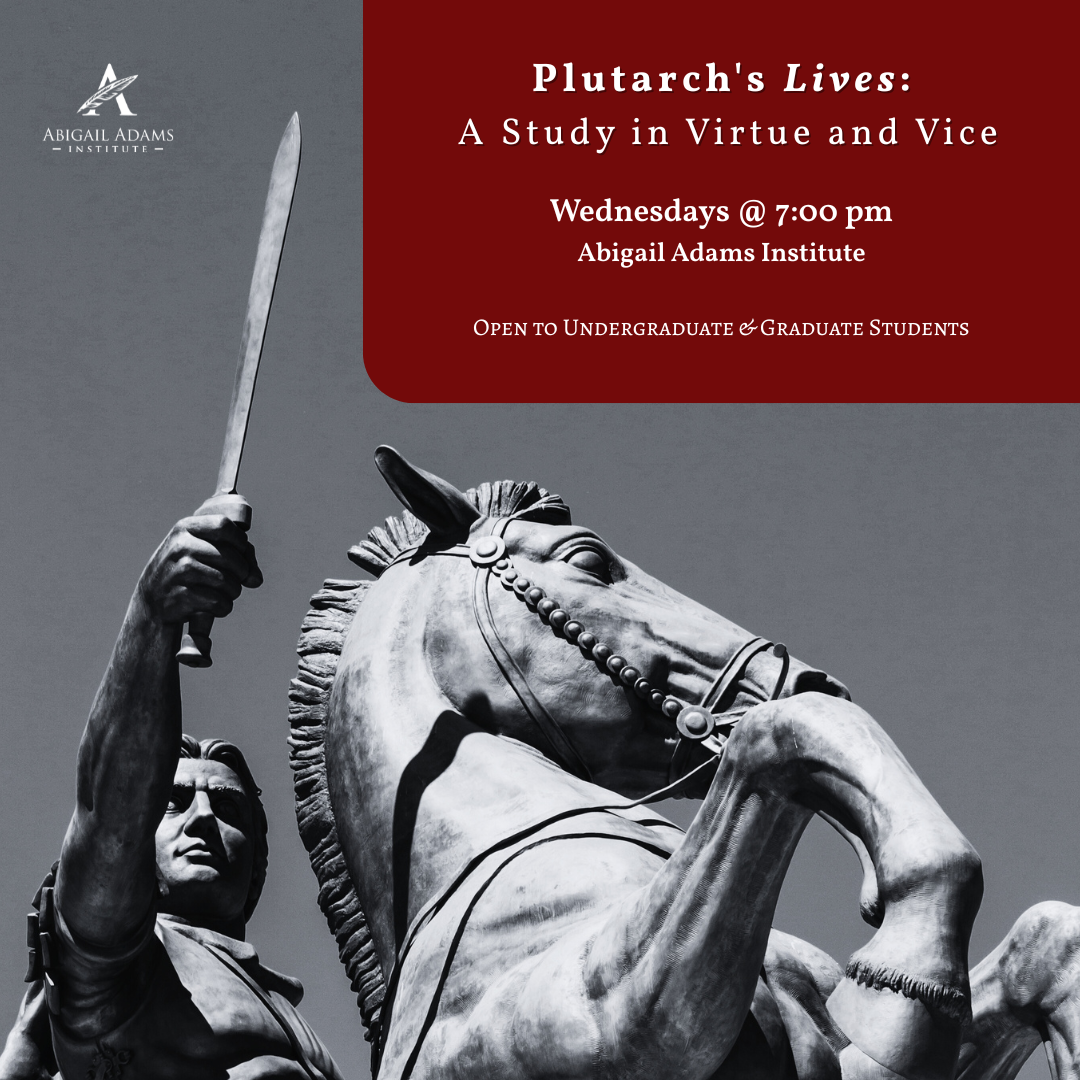
Join us at AAI this Spring for a seminar on Plutarch’s Lives.
Starting February 11, we will meet for 6 weeks every Wednesday at 7 pm PM at the Abigail Adams Institute at 14 Arrow St, Ste G10 in Cambridge.
There is no cost to the program, and each week's readings will be provided to all participants.
Open only to Undergraduates and graduate Students At Harvard and boston-area universities.
Registration required— register below.
“Fill your souls with Plutarch, and when you have faith in his heroes, dare at the same time to believe in yourselves. With a hundred such men, raised in this unmodern way, that is to say, people who have become mature and familiar with the heroic, one could silence the whole noisy sham-culture of our age forever.”
—Nietzsche, On the Use and Abuse of History for Life, section 6, from Untimely Meditations.
When Shakespeare sought to understand the rise and fall of the Roman republic, and the talented and ambitious men who made, sustained, and destroyed it, he turned to the greatest biographer of the ancient world: Plutarch (AD 46-120). Plutarch’s Lives became the staple of liberal education, and for a time it was the most common book, after the Bible, in American homes. His biographies kept the memory of those men and their world alive down to our time, directly and through the statesmen and thinkers who studied him with care, a list that includes Machiavelli, Montaigne, Bacon, Hamilton, Napoleon, Rousseau, Emerson, and Goethe.
Yet what need have we of Plutarch’s heroes, raised as we are in a world of bourgeois virtues—of security, commerce, tolerance, and individualism? Surely we would find little to learn from the lives of those who rose up in a world of martial valor, ferocious republics, pagan gods, and strange moralities. Still, it may give us pause that so many of the makers of the modern world—our own educators—educated themselves through the lives of Plutarch. Perhaps he has something to teach us as well. How can we know that the standard by which we judge who is admirable and good is the true one without stepping beyond the horizon of our own time, our politics, our morality? How can we claim to know what is right without closely examining—with the help of sharp and sympathetic eyes—very different types of human beings, such as an Alexander, a Caesar, a Cicero, who become prominent only in societies who honor very different qualities than we do? Most of all, how can we claim to know ourselves without such knowledge?
For the question for Plutarch is the same as for us, if we are sufficiently thoughtful and self-reflective: What is virtue or goodness for a human being?
Themes:
I. The great man at war with his republic (Alcibiades & Coriolanus)
II. The great man as his own nation: kingship and empire (Alexander the Great & Julius Caesar)
III. The great man serving his republic (Cicero & Cato the Younger)
Register
“For it is not Histories that I am writing, but Lives; and in the most illustrious deeds there is not always a manifestation of virtue or vice, nay, a slight thing like a phrase or a jest often makes a greater revelation of character than battles where thousands fall, or the greatest armaments, or sieges of cities.”
—Plutarch, Life of Alexander, section 1.
“Above all Plutarch became my favorite reading. [From him, I] formed that free and republican spirit, that indomitable and proud character, impatient with the yoke and servitude which has tormented me my whole life in situations least appropriate for giving vent to it. Ceaselessly occupied with Rome and Athens; living, so to speak, with their great men, myself born the Citizen of a Republic …. I believed myself to be Greek or Roman; I became the character whose life I read: the account of the traits of constancy and intrepidity which had struck me made my eyes sparkle and my voice strong.”
—Rousseau, Confessions, i.3.4

Discussion will be led by Manuel Lopez, who taught political philosophy at the University of Chicago after receiving his undergraduate and law degrees from Harvard. His academic research has centered on Plato and his understanding of the relation between justice and eros. He currently serves as AAI’s Scholar-in-Residence.