
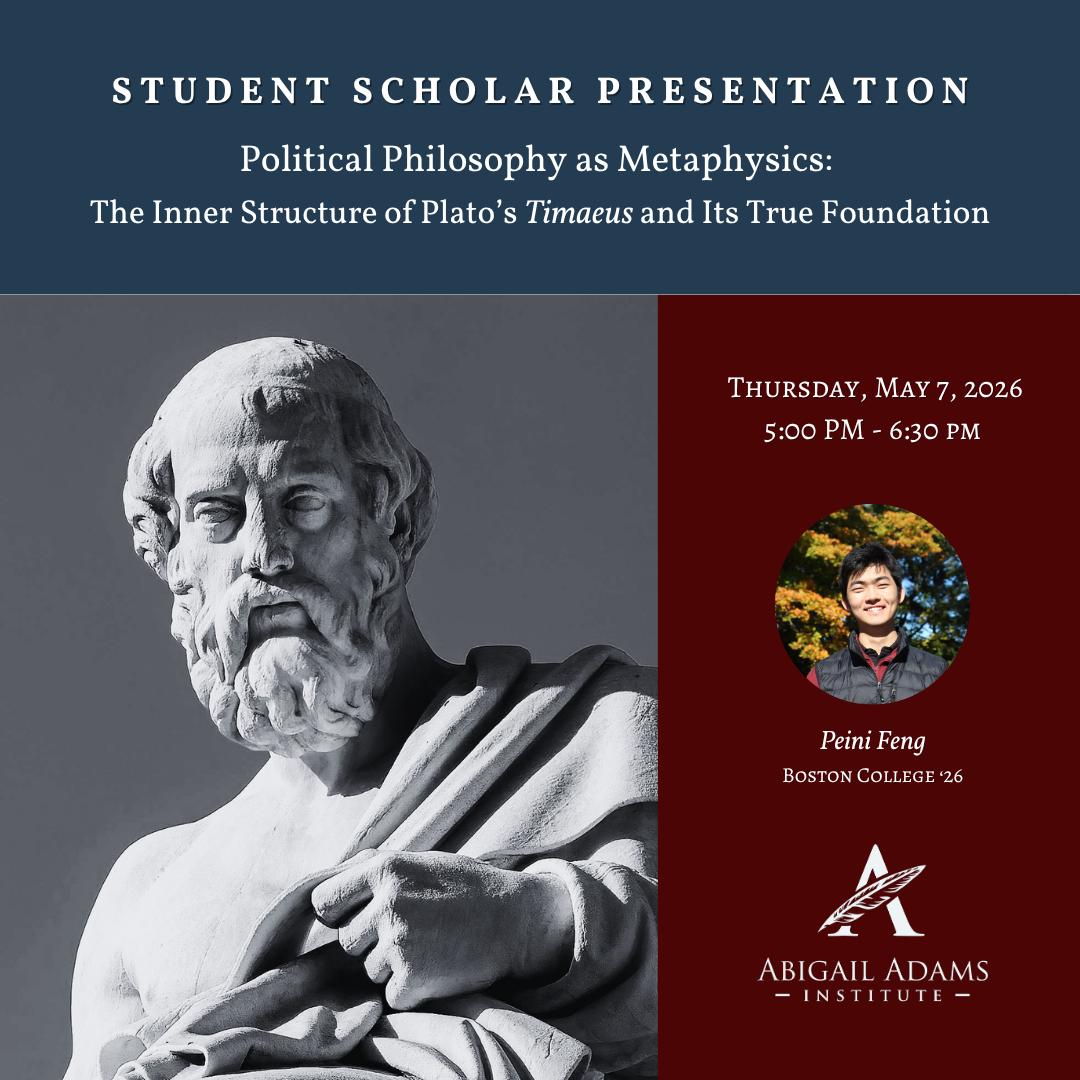
Political Philosophy as Metaphysics: The Inner Structure of Plato’s Timaeus and Its True Foundation
Peini Feng, Boston College ’26
In Plato's Timaeus, Timaeus tells a likely story about the All so that he can provide a nomos (law/song) for the nature of man. For a story to be likely, it must respond to our observation of the All, and this observation is almost self-contradictory: We must admit that the world is both beautiful and ugly. Therefore, Timaeus must account for why the world is beautiful and why it is ugly. In particular, he must answer how human beings can pursue the beautiful and respond to the ugly, and why human nature must be a mixture of both. In examining how Timaeus develops his arguments, we will discover that he relies not only on his knowledge of nature and its necessity, but also on Socrates's account of the good revealed in the best regime. Timaeus's nomos of the All and human nature, then, is revealed to be a development of Socrates's political philosophy into metaphysics. We therefore discover that political philosophy may supply some essential principles for metaphysics and directs its major trajectory.
5:00 pm
Thursday, May 7
McGuinn HALL 221A
Boston College

Peini Feng, BC ‘26
Peini is an undergraduate studying political science at Boston College. He is particularly interested in the political implications of different metaphysical stances, and whether revelation is necessary for the best kind of life.